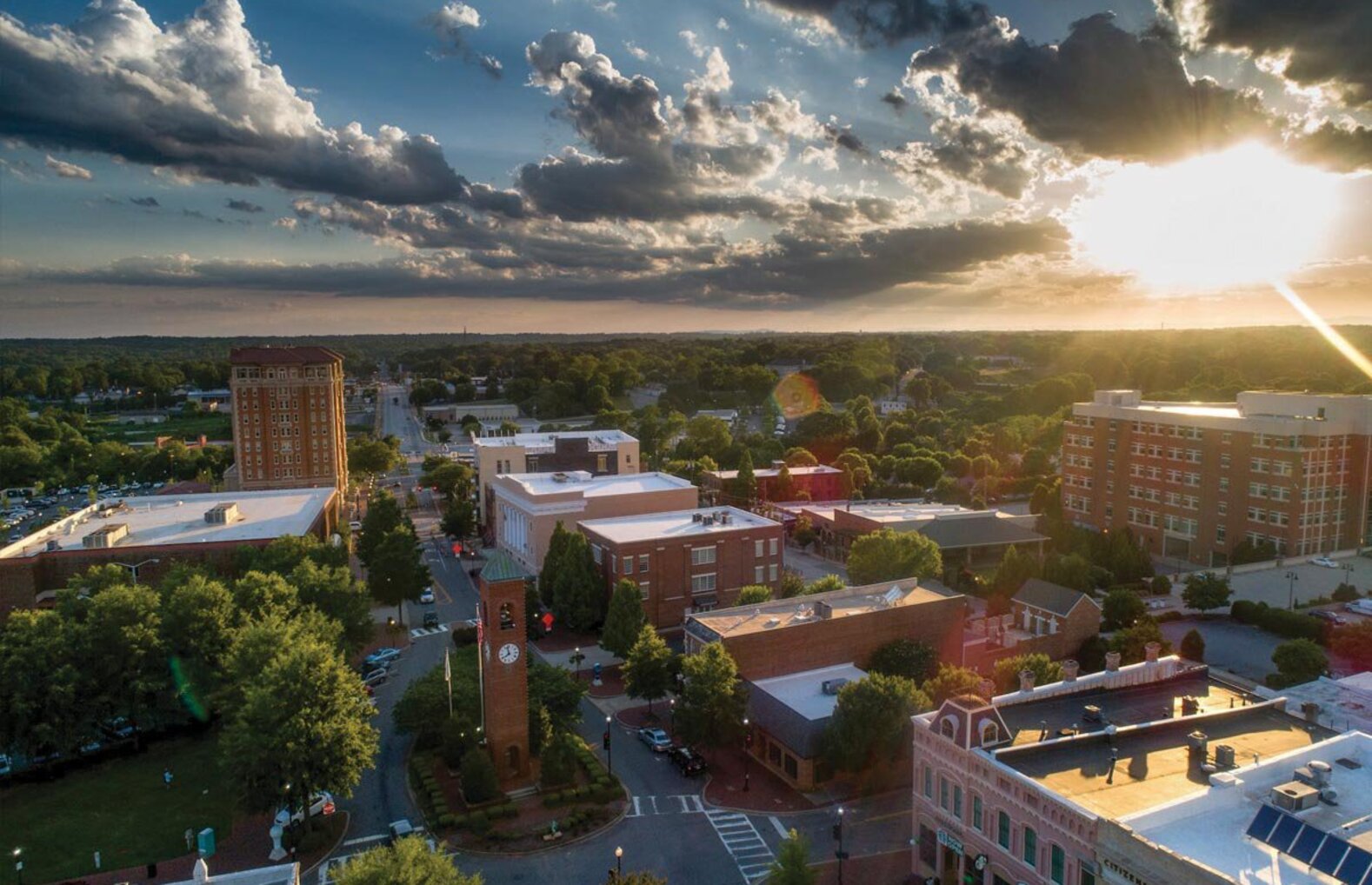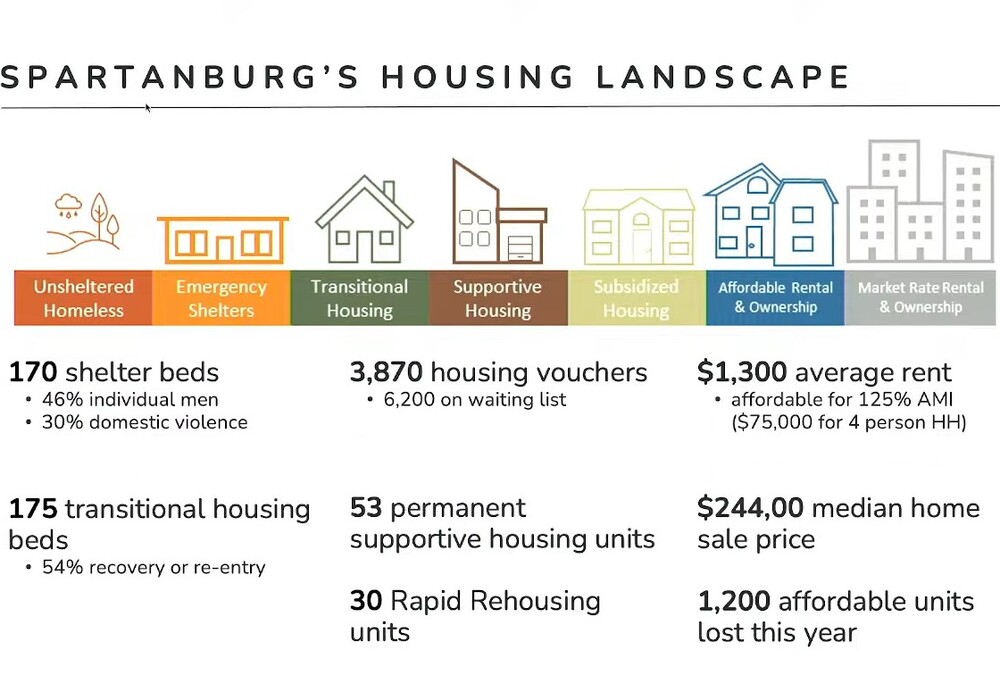

Statistics for Spartanburg’s current housing landscape. Courtesy of Hannah Jarrett
Editor's Note: The following is part one of a three-part series
Chances are pretty high that you will see at least one of many forms of progress: multi-county industrial parks, long overdue road improvements and intersection overhauls, a new baseball franchise in Inman, efforts to grow and sustain small business through Power Up Spartanburg, bustling hotels and restaurants in a vibrant downtown, and a state-leading $3.5 billion in capital investment in 2025 that is driving a ton of future growth and industry.
But unless you happen to be in the right place at the right time, chances are equally as high that you might never see the other side of all this affluence: It is the longstanding problem of homelessness, which, ironically, amidst all the prosperity, has increased in the past year.
And between now and the end of the decade, efforts often invisible and behind the scenes are not only taking place right now to wipe out this problem in Spartanburg County, but attempting to set a definitive example of how it could, in the not-so-distant future, perhaps be wiped out completely.
“We know there are at least 3,000 people experiencing homelessness in our community on any given night – and half of them are children,” said Hannah Jarrett, executive director of A Place To Call Home, a county-wide initiative formed in March 2025 to provide homeless assistance in many ways. “That’s up 22% from 2024. Your own kids probably sit behind homeless kids in the classroom and don't even know it.”
She added that contrary to logic and reason, homelessness anywhere in the U.S. is often directly proportional to area wealth, especially as housing costs have risen to largely unattainable levels in the past six years since the COVID pandemic.
“Economic growth and homelessness can exist at the same time because employment alone does not solve homelessness,” Jarrett said. “A job does not guarantee that someone can find or afford housing.”
For example, based on reports by the National Association of Home Builders in Washington, D.C., house prices climbed 54.9% nationwide between the first quarter of 2020 and the third quarter of 2025.
This means that a home priced at $200,000 before COVID surged in value to $309,800 in just over five years.
And in a March 2026 update by Realtor.com of Austin, Texas, the median home price for Spartanburg County is comparable to this surge at $304,900.
“So despite the prosperity, wages have not kept pace with rising rents,” Jarrett said. “Even people who are working can be priced out of the housing market.”
What is ALICE?
Those at risk of losing their home is a key focus of an organization called ALICE.
Founded by The United Way in 2009 and based in Cedar Knolls, N.J., ALICE stands for Asset Limited, Income Constrained, Employed.
Organization members use standardized measurements to determine the cost of a basic household budget in each county of 35 partnering states, including South Carolina, and to see how many households are unable to afford that budget.
ALICE is the research mechanism used by APTCH to determine household levels for Spartanburg County.
Consider: Of South Carolina’s 2.16 million households (5.6 million residents), more than 914,000 are below the ALICE threshold.
Which means that about 42% of all state households are judged to be only one lost paycheck or unexpected life event from losing their home, apartment, or other dwelling.
“And in Spartanburg County, residents below the ALICE threshold are at 50%,” Jarrett said.
That’s roughly 190,000 people – a figure expected to go up significantly as the county’s projected population heads toward 500,000 in the next 15 years.
“So while Spartanburg’s economic growth is a major strength, the Government Accountability Office found that every $100 increase in median rent is associated with a 9% increase in homelessness,” Jarrett said. “That trend is very real in Spartanburg County.”
Waiting List – Critical Need
It is precisely that trend that APTCH intends to halt. But the work to get there is formidable.
In just over a year, APTCH members have built the county’s only overnight family homeless shelter – one of only two in South Carolina, and the only transitional housing or shelter within a 50-mile radius.
But the shelter accommodates only 4 families (16 individuals).
“And the shelter is full most of the time,” said APTCH manager Beth Rutherford, who has worked with the homeless for more than 20 years.
Both she and Jarrett pointed out that while the shelter is a start, it is a far cry from serving all those in need.
“We have 3,870 housing vouchers through our housing authority in this community with a 3-to-5-year waiting list,” Jarrett said. “But we have 6,200 people on the list.”
Rutherford added that housing is only one consideration.
“The soup kitchens serve 150 people every day,” she said. “And our public transportation system doesn’t go outside the city, so that’s another concern for getting them a job.”
Running it all are 400 APTCH volunteers and 10 staff members – just enough to start the homeless train moving.
“Since late March 2025, we have served 578 households comprised of a little over 1,000 people,” Jarrett told the Spartanburg City Council on April 13 during her one-year update. “Our volunteers do all of the 6 p.m. to 7 a.m. operations of our family shelter. We have played an active and ongoing role in exiting 132 people from homelessness. And we facilitate and manage 109 partnerships to make this impact and work possible.”
And in just the next year alone, Jarrett and Rutherford are bracing for an increase of every factor, including the money to make it all happen.
“I could talk about this for days and hours and weeks, and so can the team,” Jarrett said. “We’re meeting a very, very critical need in our community.”
Next Week: Money, Stress, Perception